Choosing a supplier is one of the most consequential decisions in supply chain management. A supplier sits inside an open system — the supply chain — so every selection is shaped by economic, political and market conditions. Get it right and you gain stable quality, competitive cost and reliable delivery; get it wrong and the impact ripples through production, inventory and customer satisfaction.
This guide walks through what buyers actually look for, the Q.C.D.S. principle, a seven-step selection process, the common selection methods, and the practical considerations that separate good sourcing decisions from costly ones.

What Buyers Look for in a Supplier
1. Quality
Quality is the foundation of supply chain survival. The value of a product rests on its quality — it determines the quality of the end product and directly affects market competitiveness and market share. That is why quality is the most important factor when evaluating a supplier.
2. Price
Lower prices directly reduce operating costs and boost competitiveness and profit margins, which makes price a major factor in supplier selection. But the cheapest supplier is not always the right one — price must be weighed against product quality, delivery time, transport costs and many other factors.
3. On-time delivery
Whether a supplier delivers the right product to the right place at the agreed time determines the continuity of production and supply. Late or unreliable delivery raises inventory levels all the way up the supply chain, slows the response to market changes, and disrupts both production schedules and sales plans.
4. Product flexibility
To survive intense competition, manufacturers must offer a diverse product range that tracks consumer demand — that diversity is built on the supplier’s product flexibility. The variety a supplier can produce ultimately decides the range of products a company can bring to market.
5. Other factors
Design capability, special process capability, overall service level and project management capability all play a role in supplier selection.
The Q.C.D.S. Principle
Supplier development follows the Q.C.D.S. principle — Quality, Cost, Delivery and Service weighed equally.
Of the four, quality comes first. Confirm that the supplier runs a stable, effective quality assurance system, and has the equipment and process capability to make the specific product you need. Cost and price come next: use value engineering (VE) to analyze the cost of the product, and pursue savings through win-win price negotiation. On delivery, verify that the supplier has sufficient production capacity, adequate manpower and the potential to scale. Finally — and critically — check the supplier’s record of pre-sales and after-sales service.
The Supplier Selection Process
Suppliers play a vital role in the supply chain, and selection mechanisms vary. Different companies use different steps, but a sound process generally includes the following:
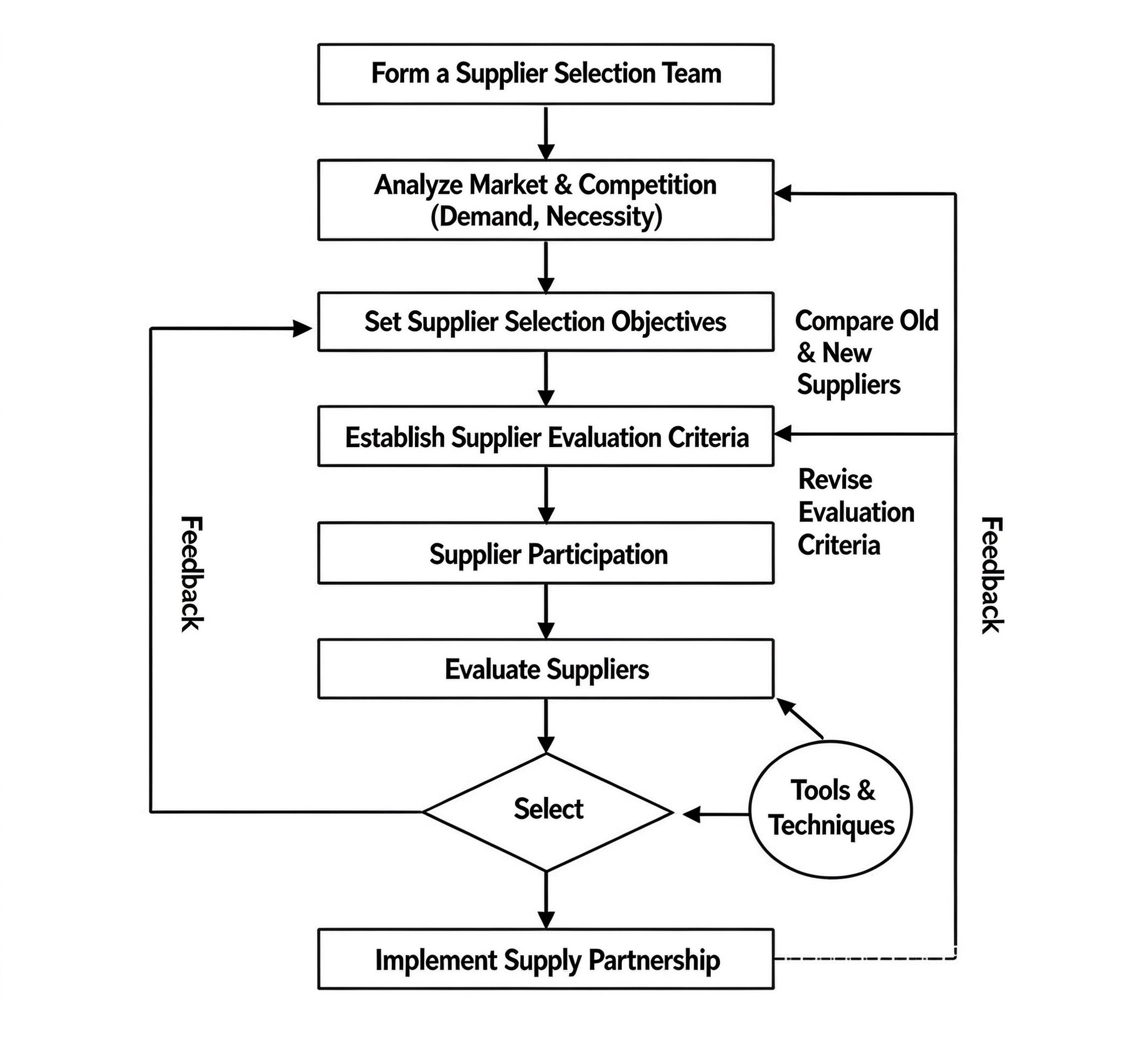
1. Form a supplier selection team
Set up a dedicated team to control and implement supplier evaluation. Members should come mainly from purchasing, quality, production and engineering — the departments closest to the supply chain relationship. Team members need teamwork skills and professional competence, and the team must have the backing of top management on both the buying and the supplying side.
2. Analyze the market and competition environment
Understand current product demand, product types and characteristics, and confirm whether a supply relationship is necessary. If one already exists, re-check whether it needs to change as demand shifts, analyze the current suppliers’ situation and summarize the company’s problems.
3. Set supplier selection objectives
Decide how the evaluation program will run and set substantive goals. Supplier evaluation is not just a process — done well, it is a business-process re-engineering exercise that delivers a stream of benefits.
4. Establish supplier evaluation criteria
An evaluation index system is the basis for a comprehensive assessment of suppliers. It should cover supplier performance, equipment management, human resource development, quality control, cost control, technology development, customer satisfaction and delivery agreements. Requirements differ with the company’s situation and the selection time horizon, so distinguish short-term and long-term criteria:
Short-term criteria: appropriate product quality, low cost, timely delivery, good overall service (installation, training, maintenance, upgrades, technical support), and the commitment and capability to fulfill contracts.
Long-term criteria: a sound supplier quality management system, advanced and well-maintained internal equipment, stable financial condition, good internal organization and management, and a stable workforce.
Combine both sets of criteria — only then can the evaluation be comprehensive and lead you to the right supplier.
5. Supplier participation
Once the company decides to run a supplier evaluation, involve suppliers in designing the evaluation process as much as possible, and confirm whether they have the desire to achieve higher performance levels.
6. Evaluate suppliers
Collect comprehensive information about each supplier’s production and operations, then use the appropriate tools and techniques to score and select.
7. Implement the supply partnership
Market demand keeps changing. Adjust the evaluation criteria as circumstances require, or restart the selection process. When reselecting, give both incumbent and new suppliers enough time to adapt.
Supplier Selection Methods
Methods and tools for supplier selection fall into three families: qualitative, quantitative, and a combination of both. Common examples include open competitive bidding, negotiation selection, ABC costing, linear programming, the Analytic Hierarchy Process (AHP), fuzzy comprehensive evaluation, neural network methods, TOPSIS, Data Envelopment Analysis (DEA), principal component analysis (PCA), grey comprehensive evaluation, and integrated applications of these methods. Manufacturers can choose according to their actual situation. The most commonly used methods are:
1. Direct judgment method
This is a strongly subjective method: buyers survey, solicit opinions, and rely on experienced purchasing staff to judge — often directly from experience. Its quality depends on how complete and accurate the supplier information is, and on the decision-maker’s analytical ability and experience. It is simple and fast but lacks scientific rigor, and is best suited to selecting suppliers of non-critical raw materials.
2. Assessment-based selection method
After a full investigation, the buyer seriously assesses, compares and then selects. Supplier investigation is usually divided into preliminary investigation and in-depth investigation.
Preliminary investigation — targets are chosen mainly on product specification range, quality-to-price level, production capacity and transport conditions; a few candidates are shortlisted from all qualified suppliers.
In-depth investigation — focuses on suppliers of key and important products. These suppliers are studied, examined and assessed on company strength, production capability, technical level, quality assurance system and management level.
After scoring the individual evaluation indicators, a comprehensive score is calculated as a weighted average:
S = ΣWiPi / ΣWi × 100%
where S is the composite index, Pi is the i-th indicator, and Wi is the weight of the i-th indicator, set subjectively according to relative importance. The higher a supplier’s composite score, the better its overall performance. After a trial-run phase, the composite scores basically settle the selection.
3. Competitive bidding
When purchase volumes are large and the supply market is competitive, tendering works well. The buyer acts as the tenderee, states the purchasing conditions and requirements, invites multiple suppliers to bid, and selects the best offer according to a defined procedure and standard. The whole process must be open, fair and merit-based.
4. Negotiation-based selection
When many suppliers are available and the choice is hard, negotiation-based selection is a useful alternative: shortlist several suppliers with favorable terms, negotiate with each, and then decide.
Compared with bidding, negotiation allows both sides to discuss fully, so product quality, delivery dates and after-sales service are better assured. But the limited selection pool means you may not get the cheapest or most favorable terms. Negotiation fits better when time is short, few bidders exist, competition is weak, or the product’s specifications and technical conditions are complex.
Considerations When Choosing a Supplier
1. Make vs. outsource
Generally, the higher the outsourcing ratio, the more supplier selection opportunities — and specialized partners who can divide labor are the main targets. Outsourcing lets a company concentrate on its core competencies instead of spreading itself thin.
2. Single vs. multiple suppliers
Single sourcing concentrates orders for an item with one supplier. The advantages: a close buyer-supplier relationship, stable incoming quality and lower purchasing costs. The disadvantages: no comparison with other suppliers, the risk of missing suppliers with better quality or price, less purchasing flexibility, and serious disruption to your own production if the supplier runs into problems.
Multiple sourcing spreads orders across several suppliers — its advantages and disadvantages are the mirror image of single sourcing.
3. Domestic vs. international sourcing
Domestic suppliers often offer lower prices and, being close by, enable just-in-time (JIT) production or zero-inventory strategies. International suppliers can provide products domestic companies cannot reach, raise the technology level and broaden the supply base.
4. Direct vs. indirect purchasing
For large-volume purchases or items that significantly affect operations, buy directly to avoid intermediary markups and cut costs. For small volumes or items with low operational impact, indirect purchasing saves purchasing effort and expense.
5. Avoid unscientific selection methods
Many companies still lack a sound management system and a scientific selection method. They lean on the supplier’s own written materials and introductions, market reputation, or individual subjective judgment when inviting suppliers to bid — so human factors dominate.
Selection criteria also tend to focus narrowly on product quality, price, flexibility, on-time delivery, lead time and batch size, without a comprehensive evaluation index system. Avoid these traps: build criteria that allow an objective, full and specific assessment.
The takeaway
Supplier selection is not a one-off transaction — it is a strategic process that balances quality, cost, delivery and service, backed by a disciplined, repeatable evaluation flow. At SeaForest, the same mindset drives our manufacturing partnerships: we qualify materials and suppliers rigorously so that every part we machine — and every finish we apply — holds the tolerances our customers expect.
Planning a precision-machined part and wondering how we manage material and supplier quality? Send us your drawings — our engineering team will review your geometry and recommend the right process and finish.